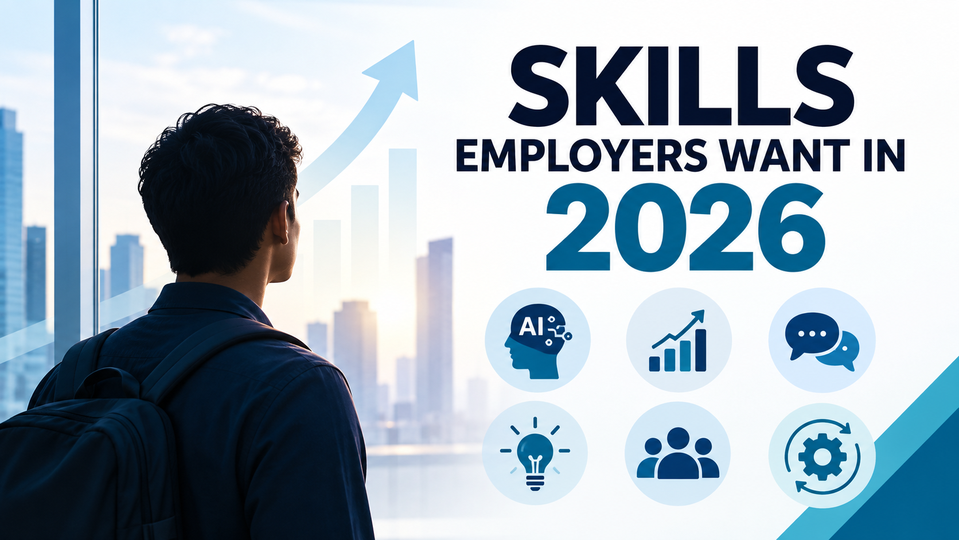
Skills Employers Want in 2026
Published September 17, 2026 • Career Growth • 11 min read
The job market in 2026 is no longer driven by degrees alone. Employers are prioritizing professionals who combine AI literacy, adaptability, communication, leadership, data fluency, and critical thinking.
As automation accelerates and hybrid work becomes permanent, companies are hiring for long-term capability — not just short-term experience. If you want career security and growth in 2026, skill strategy matters more than ever.
Key Takeaways
- Build a combination of technical, analytical, communication, and collaboration skills rather than collecting unrelated certificates.
- AI literacy increasingly matters, but the depth required depends on the role.
- Employers need evidence of skills, so turn learning into projects, work outcomes, or clear examples.
- Review your target job descriptions before choosing what to learn next.
Start With the Skill Stack, Not a Buzzword List
“In-demand skills” are useful only when connected to a real role. A software developer, analyst, project manager, designer, and customer-success professional may all benefit from AI literacy, but they will use it differently.
Instead of trying to master every trend, choose one core skill, one complementary skill, and one business or communication skill. For example: SQL + dashboarding + stakeholder communication, or Java + cloud deployment + technical writing.
1. AI Literacy & Digital Fluency
AI literacy means understanding what AI tools can and cannot do, using them appropriately, checking outputs, and recognizing risks such as inaccurate information or exposure of confidential data.
How to build it
- Learn the basics of generative AI and automation.
- Use AI on low-risk tasks such as drafting, summarization, brainstorming, or code explanation.
- Verify important outputs against reliable source material.
- Document one workflow where AI saves time without reducing quality.
2. Adaptability & Continuous Learning
Adaptability is easier to demonstrate through behavior than through a resume adjective. Show how you learned a new tool, took ownership of an unfamiliar problem, or changed a process after feedback.
Create a quarterly learning goal with a visible output: a small project, documented process, presentation, portfolio item, or work improvement.
3. Data Fluency & Analytical Thinking
Data fluency does not mean everyone must become a data scientist. Many roles benefit from being able to read metrics, question assumptions, interpret charts, and explain what a number means for a business decision.
- Understand the metrics used in your role.
- Learn basic spreadsheet and SQL skills where relevant.
- Practice turning a dataset into one clear business conclusion.
- Distinguish correlation from evidence of causation.
4. Advanced Communication & Business Storytelling
Strong work can lose impact when its owner cannot explain the problem, decision, trade-off, and result. Practice a simple structure: context → problem → action → outcome → next step.
Use the same structure on your resume, in interviews, and when presenting project updates.
5. Collaboration in Hybrid & Global Teams
Distributed work makes written communication, documentation, ownership, and handoffs especially important. Useful behaviors include documenting decisions, clarifying owners, communicating risks early, and adapting communication to different audiences.
6. Critical Thinking & Complex Problem-Solving
Problem-solving starts with defining the actual problem. Before jumping to a solution, ask what changed, what evidence exists, what constraints matter, and how success will be measured.
- Define the problem.
- Gather the relevant evidence.
- Separate symptoms from possible causes.
- Compare solutions and trade-offs.
- Test the smallest useful change.
- Measure the result.
7. Leadership & Influence at Every Level
Leadership is not limited to formal managers. It can include coordinating a release, mentoring a colleague, resolving an ambiguity, or taking responsibility for a recurring problem.
When documenting leadership, describe the situation, your responsibility, the people involved, and the outcome rather than simply writing “strong leadership skills.”
8. Sustainability & Ethical Awareness
Many professionals increasingly encounter questions about responsible technology, data handling, accessibility, security, environmental impact, and business ethics. The relevant depth varies by industry, but the ability to recognize risks and ask responsible questions is broadly useful.
9. Automation & Efficiency Mindset
Automation is most valuable when it removes repetitive work without creating new quality or security problems. Start by mapping a recurring process and identify steps that are predictable, rules-based, and low-risk.
Before automating, define the expected benefit and the failure condition. A five-minute saving is not necessarily valuable if the automated process creates an hour of review work.
How to Build These Skills Strategically
| Goal | Learning activity | Proof of skill |
|---|
| AI literacy | Complete a small workflow using an AI tool. | Document the workflow, checks, and result. |
| Data fluency | Analyze a relevant dataset. | Dashboard or short written analysis. |
| Communication | Practice concise project updates. | Before/after examples or presentation. |
| Automation | Improve one repetitive process. | Measured time saved and documented safeguards. |
How to Prove a Skill on Your Resume
Replace unsupported claims with evidence. Instead of “excellent problem solver,” describe the problem you solved, what you changed, and the measurable result when a real metric exists.
Do not invent percentages or business impact. If an exact metric is unavailable, use a precise qualitative outcome such as reduced manual steps, standardized a process, shortened a workflow, or improved documentation.
A 90-Day Skill-Building Plan
- Days 1–30: choose one target role, inspect several job descriptions, and identify the recurring skill requirements.
- Days 31–60: practice the chosen skill through a realistic project or workplace task.
- Days 61–90: document the work, improve the result, and turn it into a portfolio or interview example.
The goal is not to become an expert in 90 days. The goal is to create credible evidence that you can learn and apply the skill.
Think in Skill Stacks
A useful career profile often comes from combining skills that reinforce each other. For example:
- Developer: programming + cloud + AI integration.
- Analyst: SQL + visualization + business communication.
- Marketing professional: analytics + content systems + AI-assisted research.
- Project professional: delivery methods + data literacy + stakeholder communication.
Frequently Asked Questions
Are technical skills more important than soft skills?
It depends on the role. Technical capability may be central to one position while communication, coordination, or customer understanding may be central to another. Many jobs require a combination.
Do I need AI knowledge if I am not in IT?
The required depth varies. Basic AI literacy can be useful in many knowledge-work roles, while technical AI development requires substantially deeper skills.
What is the most future-proof skill?
No single skill guarantees long-term career security. A practical combination is the ability to learn, solve problems, communicate clearly, and apply role-specific technical knowledge.